Introducing our AI policy

Introducing our AI policy
For over 15 years, Kodeco has prided itself on publishing the best human-created tutorials, books and videos. We've helped thousands of people learn how to code, build their dream app, and get new jobs.
However, over the past couple of years, AI has changed the world of software development. It's now possible to create apps without knowing any code. It's also possible to learn how to code using AI, should you wish to.
Here at Kodeco, we believe that AI is an incredibly powerful tool that is already being used to improve the software development workflow, but that there is also a place for the skills of human developers, and that learning to code is still a valuable skill.
We've spent several months this year thinking about how we want to use AI, and how we want to keep teaching people to code in an AI world. We've been creating content that explains how to use AI, and we've been experimenting with how to leverage AI to make content creation more productive.
Today we're publishing our AI policy at kodeco.com/ai-policy, and it covers everything we publish from October 2026. We believe that there continues to be huge value in human-created content, and all content we produce will continue to be created by a human. As software engineering changes through the use of AI, we'll change with it, but we'll highlight exactly where we use AI, what was used, and to what extent it was used.
To this end, we have created five promises about our use of AI.
Our promises
- Kodeco content will continue to be human-created.
- Where an AI model has been used to assist with coding, we'll explicitly call out the model, the token usage, and the estimated API cost at time of writing.
- Any LLM usage in helping with the written content (such as proof-reading) will be clearly labelled.
- Every item of content will be human-checked and approved.
- Diagrams and illustrations will be created by people, not AI.
What you'll see on our content
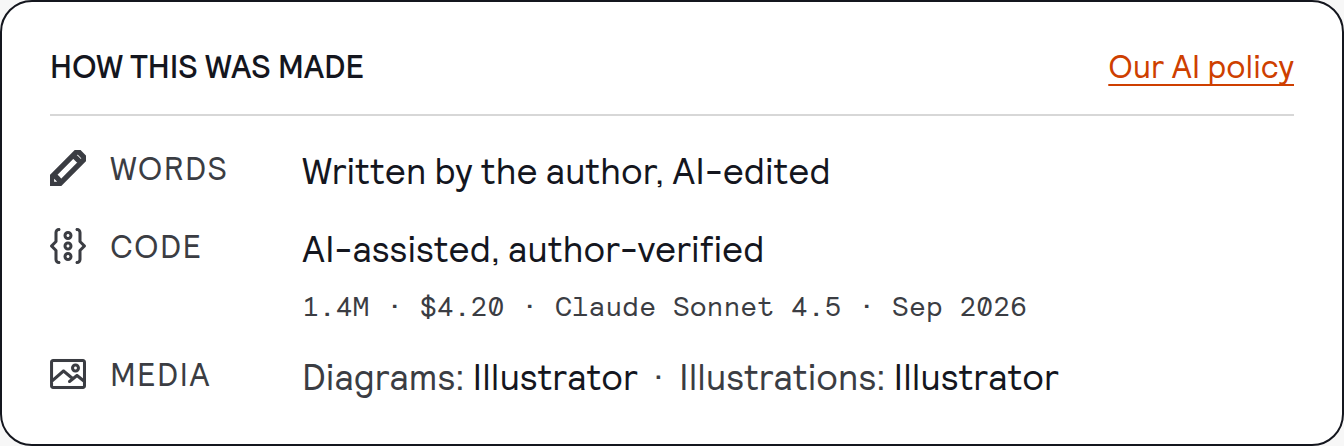
We've created our "How this was made" box, which serves as a disclosure of exactly how AI was used to create the content. It appears on articles, modules and book chapters, and has three lines: Words, Code and Media. Code that AI helped with also shows the tokens, estimated cost, model and month. Anything published before the policy shows a "Published before our AI policy" notice instead.
We see this as a pragmatic compromise between our belief that humans should learn software engineering before creating apps, and the hard reality of the changing landscape of software development.
If you notice that something in an AI disclosure looks wrong, then feel free to reach out to support@kodeco.com and we'll get it fixed.
I really hope that you'll come on this journey with us. We'll keep making human-created content for humans for as long as our learners appreciate it. We believe passionately that there is value in understanding more about software than just vibe-coding. Maybe we're wrong. But we're not going to give up without a fight.

Photo by Micke Lindström on Unsplash